
Do You Remember the Early Days of Social Media?
One thought that often comes to mind when using tools like ChatGPT, Perplexity, and other generative AI models is how similar this feels to our early engagement with social media between 2006 and 2010. Social media was revolutionary back then — no one could have predicted how it would transform the world, but it was undeniably exciting. In India, platforms like Orkut paved the way before Facebook became dominant. For the first time, we could bring our personal lives online and connect socially in new ways.
I was in my early twenties in college, and like many others, I initially used social media to impress people I had a crush on. Looking back now, those moments feel a bit embarrassing — uploading things based on how we perceived the world then. Social media has since come full circle: from sparking optimism about human rights (like during the Arab Spring) to being weaponised for political agendas and increasing government surveillance. While still strong, its influence seems to be fading.
Technologies That Appeal to the Five Senses Make a Real Impact
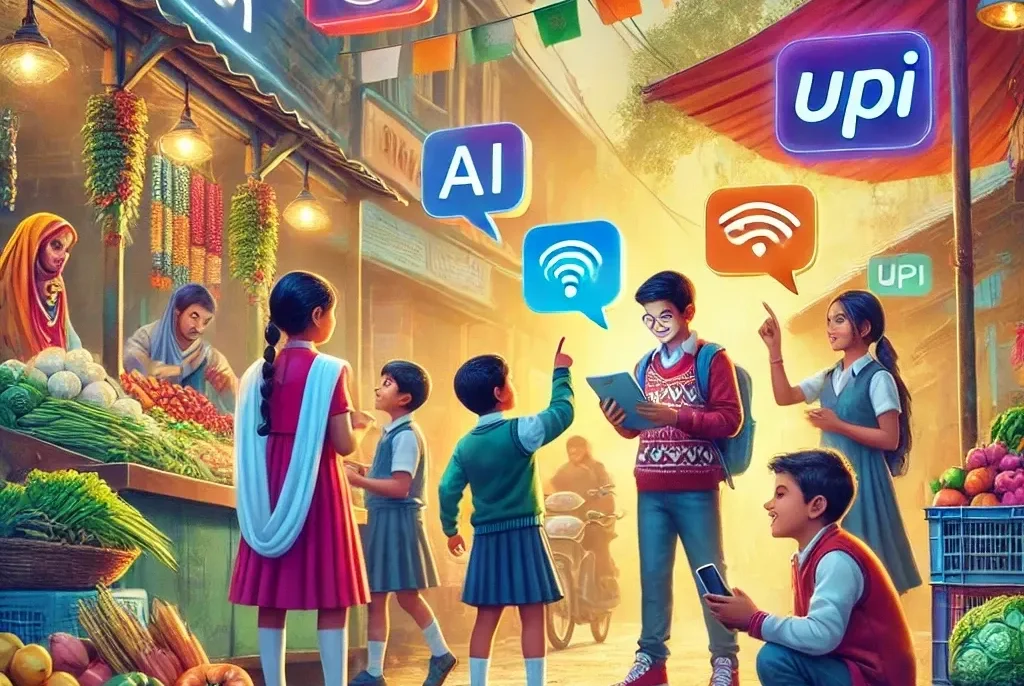
Technology revolutions in India have always favoured those who are optimistic and at least somewhat educated in English. Today, an estimated 900 million Indians use various forms of social media. However, my travels to remote parts of India have shown me that technologies interfacing with our senses — particularly voice and sight — have had the most empowering impact on people with limited access to formal education.
For example, mobile phones allowed millions to leapfrog over the landline era. Similarly, voice- and sight-enabled services with simple interfaces transform lives today. India’s success with real-time digital payment systems like Google Pay or Paytm is a testament to this. Across the country, small vendors — whether literate or not — use these platforms seamlessly. Voice-enabled chat systems on WhatsApp are another game-changer.
Looking ahead, AI could address India’s chronic challenges in education. Generative AI might eliminate the need for traditional schooling by focusing on developing cognitive skills through local-language LLM models India plans to create. This could help overcome barriers like poor infrastructure, a lack of quality teachers, and the high cost of private education. While AI may not make us rich overnight, it holds the potential to make our lives significantly better by democratising access to knowledge.
It Will Be a While Before Generative AI Becomes a Mass Product
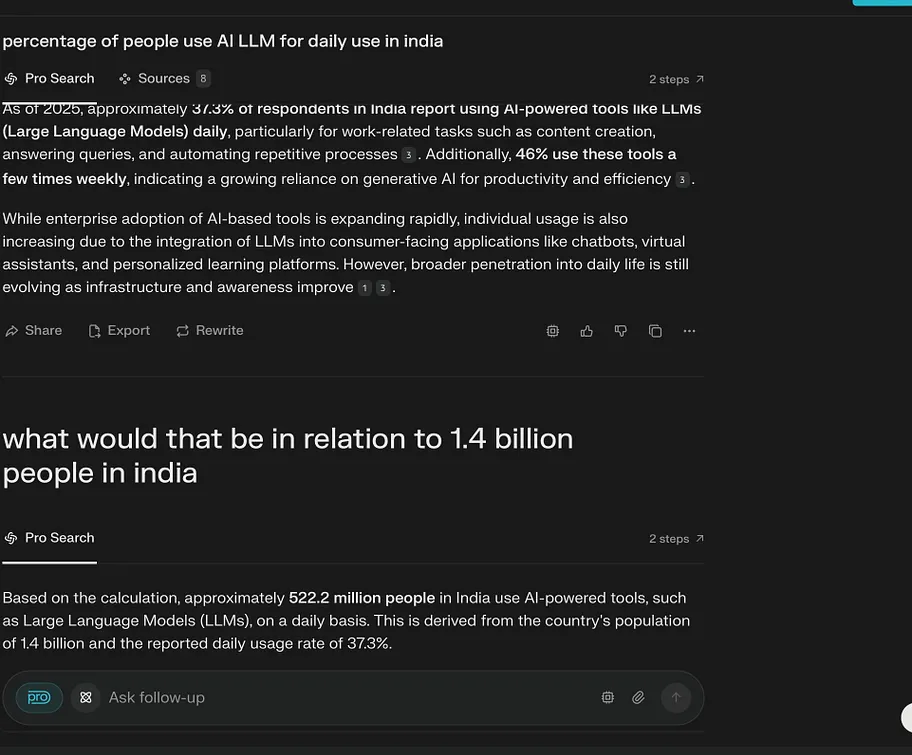
Generative AI tools like LLMs are far from being mass-market products yet. For instance, their responses varied widely when I asked ChatGPT and Perplexity about generative AI usage in India. Both models cited different sources but agreed that generative AI is primarily used by professionals, enterprises, and government bodies rather than the general population.
When I refined my query to ask about usage relative to India’s 1.4 billion people, I received an estimated 522.3 million users (around 37.3% of the population). Further narrowing my question to paying users yielded even more varied results: Perplexity estimated 52.22 million paying users based on hypothetical assumptions (10% of daily users). ChatGPT highlighted global figures without specific data for India.
This lack of precise data on paying subscribers across all LLM services is intriguing — and perhaps intentional. It underscores that while generative AI adoption is growing rapidly in India, it remains largely confined to niche segments. (see screen shots below)
Not All AI Tools Are Important for You: Master the Ones That Matter
With so many AI tools emerging daily, it’s easy to feel overwhelmed. However, experimenting with every tool isn’t practical or necessary. Instead, focus on mastering tools that align with your profession and personality.
For example, I work in research, humanitarian development, strategy, and communication. I’ve found that AI works best when paired with foundational knowledge gained through self-reading and critical thinking. It’s an excellent tool for brainstorming and fast research but should complement — not replace — your expertise.
Recently, I used ChatGPT to study intersectionality — a concept encompassing diversity across gender, race, ethnicity, and more in development programs. I achieved impressive results by cade-long experience in journalism and research with AI’s analytical capabilities. For instance, I guided ChatGPT using frameworks like “Analyze-Adapt-Access” while incorporating indicators like caste dynamics and historical context. The outcome was impactful because I controlled the inputs and leveraged my contextual understanding.
Watch Out for Short AI Courses and Keep Updating
To stay ahead in this fast-evolving field, invest time in learning how to use AI effectively:
Books: Ethan Mollick’s “Co-Intelligence — Living and Working with AI” offers practical advice on using AI as a co-worker or coach rather than just a tool.
Courses: Becki Salzman’s LinkedIn Learning course “Amplify Your Critical Thinking with Generative AI” introduces frameworks like PIQPACC that help frame better follow-up questions.
Custom Assistants: I created one tailored to my work needs after reading an HBR article on “How to Build Your Own AI Assitant” (e.g., ChatGPT’s “custom GPT”). These assistants store recurring prompts and background files for efficiency.
The key is treating AI as a digital companion — one that enhances your efficiency without replacing your expertise.
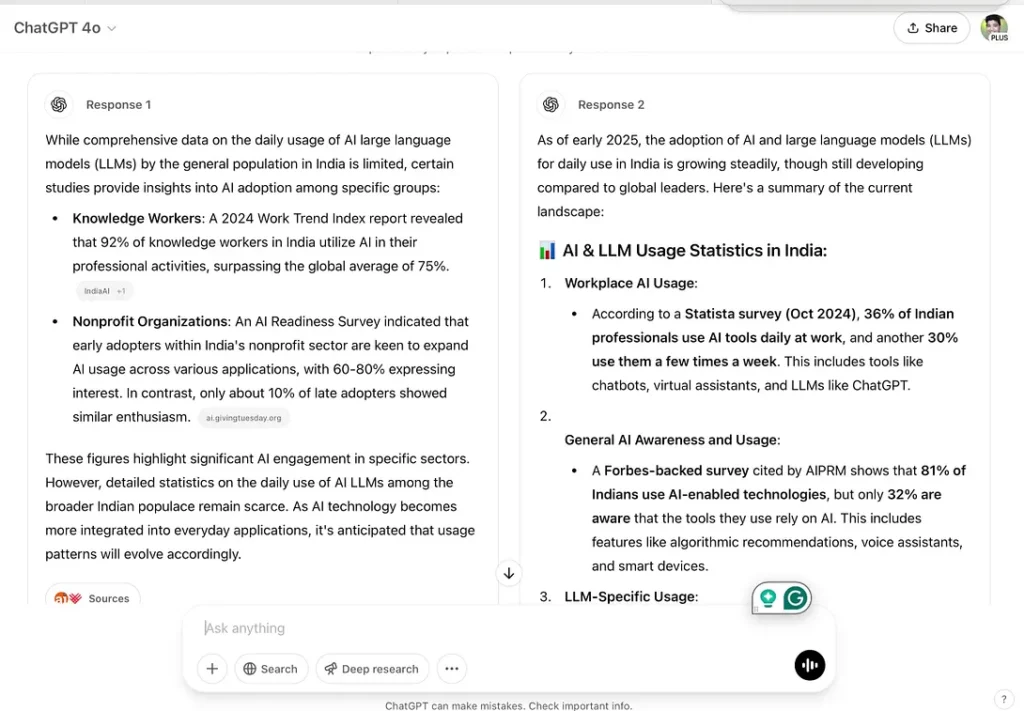
comparative answers Chat GPT and Perplexity.ai
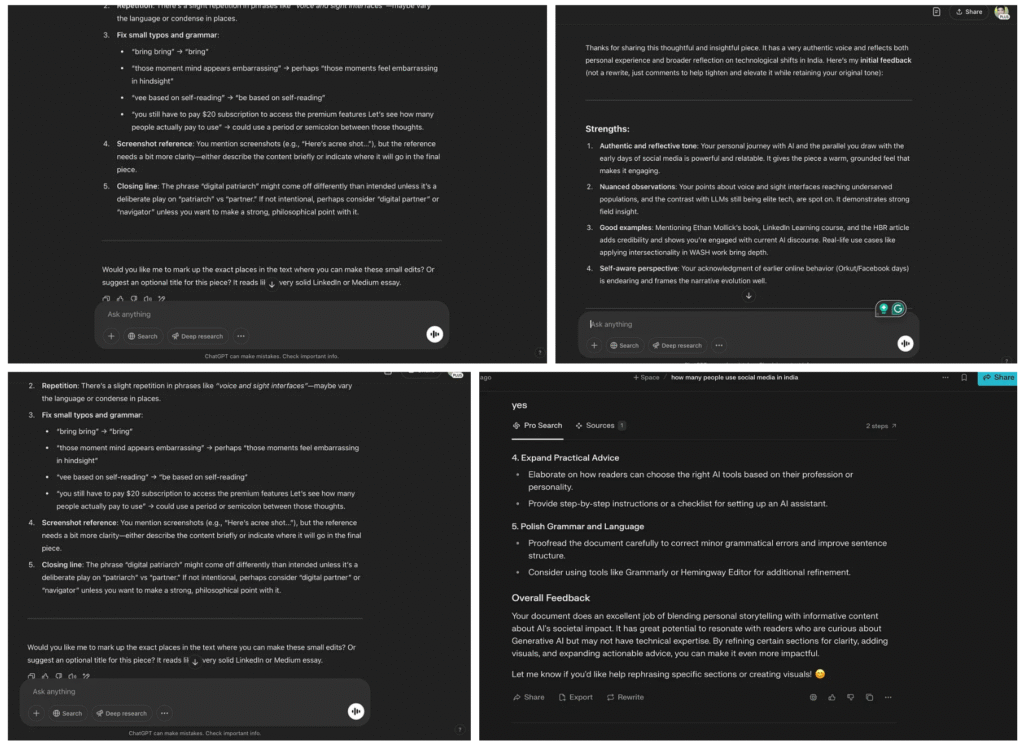
How did I make use of AI to write this article?
After writing the first draft, I asked ChatGPT and Perplexity to give me feedback. After carefully reviewing the feedback, I incorporated the changes suggested by Perplexity. ai, as I felt that there were minor and more practical suggestions. Hers’s the screen shots.